

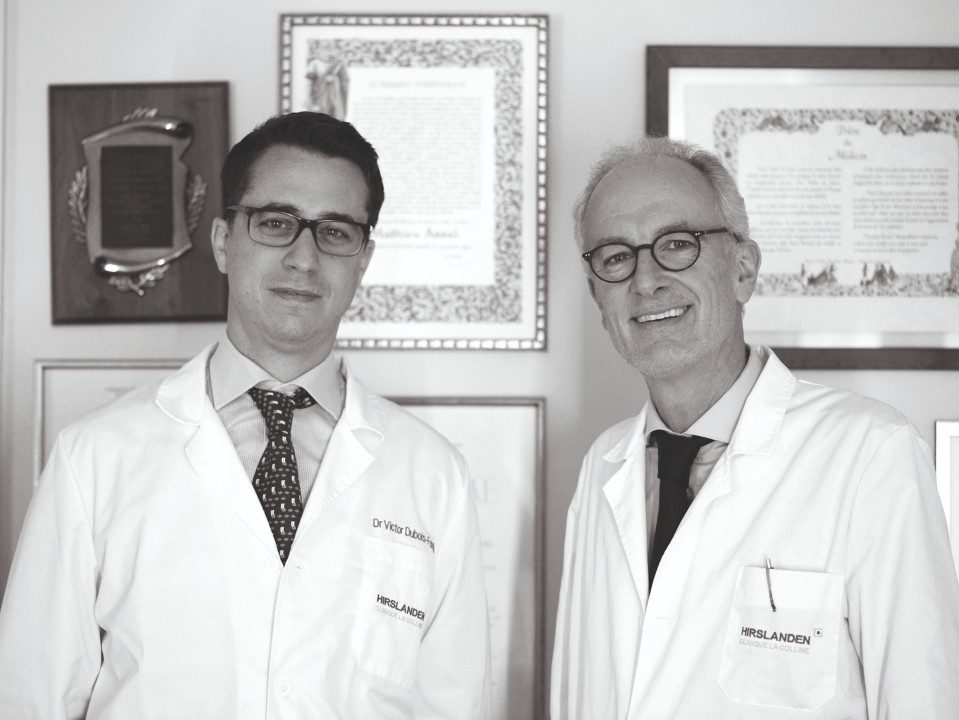
PD Dr. Mathieu Assal (MA), founder of the ASSAL Centre for Foot Medicine and Surgery, and Dr. Victor Dubois-Ferrière (VDF), who recently joined the management team, share their perspectives on the Centre, its future, and the various challenges facing the medicine of tomorrow—including patient care, new technological developments, sustainable medicine, and societal vision.
Dr. Victor Dubois-Ferrière, you have spent most of your career at the Geneva University Hospitals (HUG). Why have you chosen to join the ASSAL Centre for Foot Medicine and Surgery now?
VDF: I have known and collaborated with PD Dr. Mathieu Assal for a long time, particularly in research. We also regularly discuss clinical cases together. By a twist of fate, like him, I have also headed the foot and ankle surgery team at HUG. Our paths have therefore crossed often. Today, they are simply coming together even more.
How long has this collaboration project been in the works?
VDF: The idea of joining forces has been in the works for some time now. Today, it is becoming a reality, and I am delighted to be working alongside Dr. Assal within the same institution. The Centre brings together many experts and has a very high level of expertise; it also places great importance on research and innovation. All these factors motivated my decision to join. In addition, foot and ankle surgery is rapidly evolving; being able to actively participate in the development of a center of excellence in this field is very exciting. Especially since I will benefit from first-rate “sparring partners” within the Centre.
PD Dr. Mathieu Assal, why did you want to bring Dr. Victor Dubois-Ferrière’s expertise to the team?
MA: The Centre is growing. Bringing in new talent has become necessary to continue our momentum and further secure the future of our activities. With several generations at the helm, this addition will further strengthen our reputation and enhance our expertise. We have always had a rich and fruitful collaboration with Dr. Dubois-Ferrière, particularly in research. This is demonstrated by the innovation awards we have received for our joint work, as well as publications in prestigious, internationally renowned journals such as the American Journal of Bone & Joint Surgery and the Journal of Orthopaedic Trauma.
MA: Beyond his excellent skills as a researcher and surgeon, he will undoubtedly bring complementary expertise by strengthening a niche activity in minimally invasive and arthroscopic surgery, which has become his specialty. As we know, the more a procedure is repeated, the more precise it becomes. By increasing our surgical volume, we naturally continue to improve our practice. Furthermore, while Dr. Victor Dubois-Ferrière’s arrival will further accelerate our growth, it will also bring new momentum to the Centre: enabling the development of new techniques that will enhance patient comfort and make our interventions even safer. This also aligns with the comprehensive patient care that we strongly advocate. I know Dr. Dubois-Ferrière shares the same philosophy, and his contribution in this area will further improve the quality of our services.
Why is comprehensive patient care so important to you?
VDF: Providing patients with holistic support is fundamental because I am convinced that the synergy of different skills helps accelerate healing. I have always strived to implement this approach everywhere I have worked, and its positive impact is indisputable. By providing patients with tailored care, recoveries are faster and more lasting. That’s why we must now provide a comprehensive response to the specific needs of our patients, whether their issue concerns mobility, healing, or more generally, overall support. Surgery alone doesn’t solve everything.
Is the comprehensive patient care advocated by the Centre truly distinctive?
MA: More distinctive than ever, I am convinced of that. First of all, because I believe that surrounding the patient with all the expertise needed for their return to mobility offers them greater support. Strengthening the cross-disciplinary nature of our skills is essential. Secondly, because patients deserve access to “smart medicine”—by which I mean medicine that prescribes less, but better and more precisely. At the ASSAL Centre, based on current scientific knowledge, we will always prefer conservative treatment over surgery. In fact, we have developed a wide array of conservative options for this purpose. For us, surgery will always be a last resort—never the starting point of the discussion.
Dr. Dubois-Ferrière, what has changed for you technically since January 1st?
VDF: I personally know all the members of the ASSAL Centre team, having already worked with them either at HUG or elsewhere, which makes my integration easier. Due to measures taken during the COVID-19 pandemic, I have actually been operating at Clinique de la Colline since March 2020, so I am already familiar with the facility and the technical environment. However, it is true that this change inevitably alters the way I work. The administrative workload, which is often heavy in large institutions, will decrease, allowing me to dedicate more time to research. In addition, co-managing a medical center is also an exciting entrepreneurial project.
What is your assessment of the ASSAL Centre since its founding in 2012? What are your objectives for the future?
MA: In just eight years, the results are quite positive. The Centre now has 12,000 patients and currently performs 700 surgical procedures per year. Our progress is steady, and there is no doubt that the arrival of Dr. Dubois-Ferrière will allow us to develop even further. Our ambition over the next four or five years is to establish ourselves as the leader in foot and ankle surgery in the region, as well as to remain a national and international reference in research, innovation, and education. Maintaining our independence is also important, as it allows us to prioritize our values over any economic considerations. This is a matter of reputation and, therefore, sustainability.
What do you see as the major challenges for the medicine of tomorrow? And more specifically, in foot and ankle surgery?
VDF: The two main areas of development I see in our field concern patient management and technology. As I mentioned earlier, patient care is essential if we want to optimize the healing process. This is an approach that the ASSAL Centre invests in heavily. For example, it has implemented a data analysis system to adapt surgeries and to work prospectively on its scientific publications. The Centre also ensures and documents the follow-up of all patients in order to optimize their care. On the technology front, many advances are underway. 3D printing, in particular, is being used for the development of prostheses and instruments. Among the latest innovations, there is also computer-assisted intraoperative navigation and the implementation of new minimally invasive or arthroscopic surgical techniques. I already practice these, and the Centre is also further developing them. These advances will ultimately allow us to better tailor our interventions to each patient’s pathology.
MA: I would add to these two points by highlighting the importance of transparency in our profession. This is an area where we must continue to make progress at every level. Transparency towards patients, of course, but also towards employees, insurance companies, and public authorities. While the concept of medical ethics is supposed to be inherent in our practices today, it must now also be reflected in the way we manage a healthcare organization. This is a real challenge for us and for all stakeholders in the sector.
So responsibility and sustainability are major issues for the healthcare sector?
MA: Absolutely. Sustainability is an important issue for all organizations, including those in healthcare. In this context, we want to contribute to redefining their role in society, even at our own scale. The ASSAL Centre, which has 25 employees, has therefore taken steps to develop its corporate social responsibility (CSR) policy at every level and with respect to all its stakeholders. We are also following the B-Corp certification process, which will be completed during the first quarter of 2021. We will then be the first medical institution in Switzerland to obtain this label. This initiative is just a first step. In addition to ensuring we meet current standards, it demonstrates our ambition: to set ourselves very high—and sometimes demanding—targets for social and environmental performance. Medicine too must evolve to become more sustainable.