


The recent development of less invasive surgical techniques, minimally invasive or percutaneous, allows us to effectively treat a variety of foot and ankle pathologies. These are performed through millimeter incisions and allow the preservation of the tissue envelope around the foot. The success of these techniques requires a high level of expertise in the field and a perfect knowledge of the anatomy of the foot and ankle. ASSAL surgeons are pioneers in the practice of these techniques and have themselves contributed to their development and refinement.
Effective for certain foot deformities such as bunion (hallux valgus) or claw toes, minimally invasive foot surgery consists of a 2-3 mm incision leaving almost no scarring. However, this surgery remains delicate and requires a lot of experience in order to restore a perfect balance to the foot.
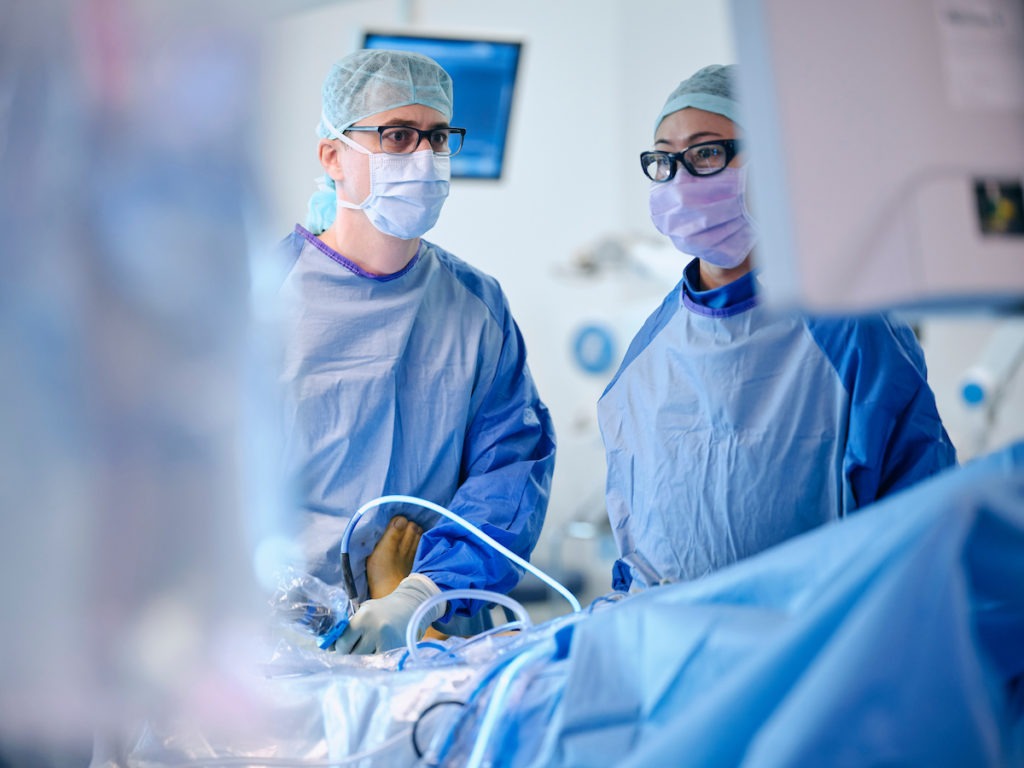
Highly effective for certain foot deformities such as bunions minimally invasive foot surgery consists of a 2–3 cm incision that leaves practically no scar. Nevertheless, this surgery is tricky and requires extensive experience for foot balance to be restored perfectly.
Dr Assal invented the minimally invasive Achillon® method, a surgical technique used to repair acute Achilles tendon ruptures. In light of its outstanding success rate, this technique is now used worldwide.
Minimally invasive foot or ankle surgery is also performed when a dynamic foot deformity or a neurological disease requires that a tendon be transferred to another insertion point to restore the lost motion.
Certain fractures are better treated using less invasive surgical methods, such as those in the lower leg, calcaneus or mid-foot.
Percutaneous approaches allow bone to be cut through millimeter-sized incisions. By limiting the size of the incision, scarring problems are reduced and bone healing capacity is optimized. This is the case in heel bone (calcaneus) repositioning osteotomies, which is often necessary in the correction of symptomatic flat feet.
When surgical treatment is deemed necessary, technology can be used to support the medical procedure to ensure maximum precision. Depending on the specifics of certain fractures, deformities or alignment defects, computer-assisted foot and ankle surgery can facilitate procedures in the affected areas. As a pioneering player in this field, Centre ASSAL has developed a treatment protocol for these types of procedures.
When fractured bones need to be joined back together, computer-assisted surgery allows the surgeon to work with millimeter-level precision. This makes the procedure safer both in terms of implant placement and outcome.
Certain fusion procedures, where cartilage is removed from two adjacent bones to join them, also use computer technology to optimize implant placement. This type of foot or ankle surgery is used with severe deformities such as Lisfranc injuries, flat feet, heel misalignment, etc.
In order to make the precise bone cut needed to restore a joint’s natural alignment, the use of computer technology in certain cases can increase the effectiveness of the foot and ankle surgery, while ensuring optimal placement of the surgical implants.
Certain conditions, such as misaligned bones and joints, deformities, arthritis and fractures, require a more extensive procedure than simple percutaneous surgery. Whether for foot, ankle or leg surgery, the surgeons at the Centre ASSAL have extensive experience in conventional surgical techniques, which means they can perform even the most delicate procedures to help you quickly regain your mobility and resume your activities (walking, sports, etc.).
Depending on the fracture’s severity, an open surgical procedure may be the best way to restore the broken bone to its initial shape. Open surgery is performed when the other options are not feasible.
Osteotomy is one of the most common foot and ankle operations. It is conducted as an open surgical procedure when a specific deformity has developed because of poor bone or joint alignment (bunion, toe deformity, metatarsalgia, flat feet, etc.). This foot and ankle surgery consists of making cuts in the bone to restore its natural alignment.
Fusion or arthrodesis is another common procedure performed as open surgery when a joint is severely damaged or has become significantly deformed (bunion, hallux rigidus, Lisfranc injury, flat feet, heel misalignment, etc.). This foot and ankle procedure consists in removing the damaged cartilage between adjacent bones and then joining these bones with screws and/or plates.
When chronic inflammation of the ankle joint arises as a result of the gradual destruction of the cartilage, total ankle replacement (TAR) is performed through an open surgical procedure. A true leader in this field, Centre ASSAL has nearly 20 years of experience with TAR. Working in collaboration with Prof. Xavier Crevoisier of the CHUV, PD Dr Assal has performed more than 400 TAR procedures and has revised nearly 500 prostheses.